
TL;DR
Choose a headshot alternative by its personalization controls, delivery format, and revision process rather than gallery size. Compare a headshot-focused service with an editing-led option, then check likeness, download terms, and total cost before purchasing.
The best Fotor AI headshot alternatives depend on what needs to change: the portrait itself, the editing workflow, or the way finished images are delivered. A polished sample gallery doesn't answer all three questions.
AI headshot generator: A tool that uses artificial intelligence to create portrait images intended for professional or personal profiles.
Fotor: An online photo-editing platform developed by Chengdu Everimaging Science and Technology Co., Ltd., launched in 2012, with editing and AI image tools.
For audience-specific exploration, Looktara provides headshot pages organized around named professional and publishing contexts. The broader shortlist below separates those contexts from editing-led and headshot-focused choices.
Table of Contents
Fotor AI headshot alternatives at a glance
The most useful shortlist separates audience-specific pages, general editing tools, and headshot-focused services before comparing purchase details.
This November 2026 comparison is a starting point, not a performance ranking. The available research identifies relevant services but doesn't establish current prices, resolution limits, revision allowances, or privacy terms. Those details require confirmation on the selected plan.
November 2026 shortlist by buyer need
| Option | Supported comparison point | Buyer need to explore | Deciding check |
|---|---|---|---|
| Looktara | Published pages address specific headshot contexts | Audience-led exploration, including fitness LinkedIn and resume portraits | Match the page to the intended profile |
| Fotor | Combines photo editing with AI image tools | Portrait creation alongside broader editing | Confirm which tools and exports the plan includes |
| Canva | Offers an AI headshot generator within a design platform | A portrait used in a wider design workflow | Check generation access and final download terms |
| HeadshotPro | Appears in the supplied headshot-generator research | A headshot-focused shortlist candidate | Review current packages and revision rules |
| Dreamwave | Appears in the supplied headshot-generator research | Another dedicated portrait candidate | Compare personalization and delivered files |
| Aragon | Appears in the supplied headshot-generator research | Another dedicated portrait candidate | Compare likeness examples and plan conditions |
An editing-led option can make sense when the portrait is only one part of a larger asset. A dedicated generator belongs on the shortlist when portrait production is the central task. Neither category automatically delivers better likeness.
Selection principle: Compare the deliverable and revision workflow, not just the number of images advertised.
Who should pick which headshot workflow?
Job seekers, business owners, creators, and dating-app users should choose according to the image's destination and the amount of control required.
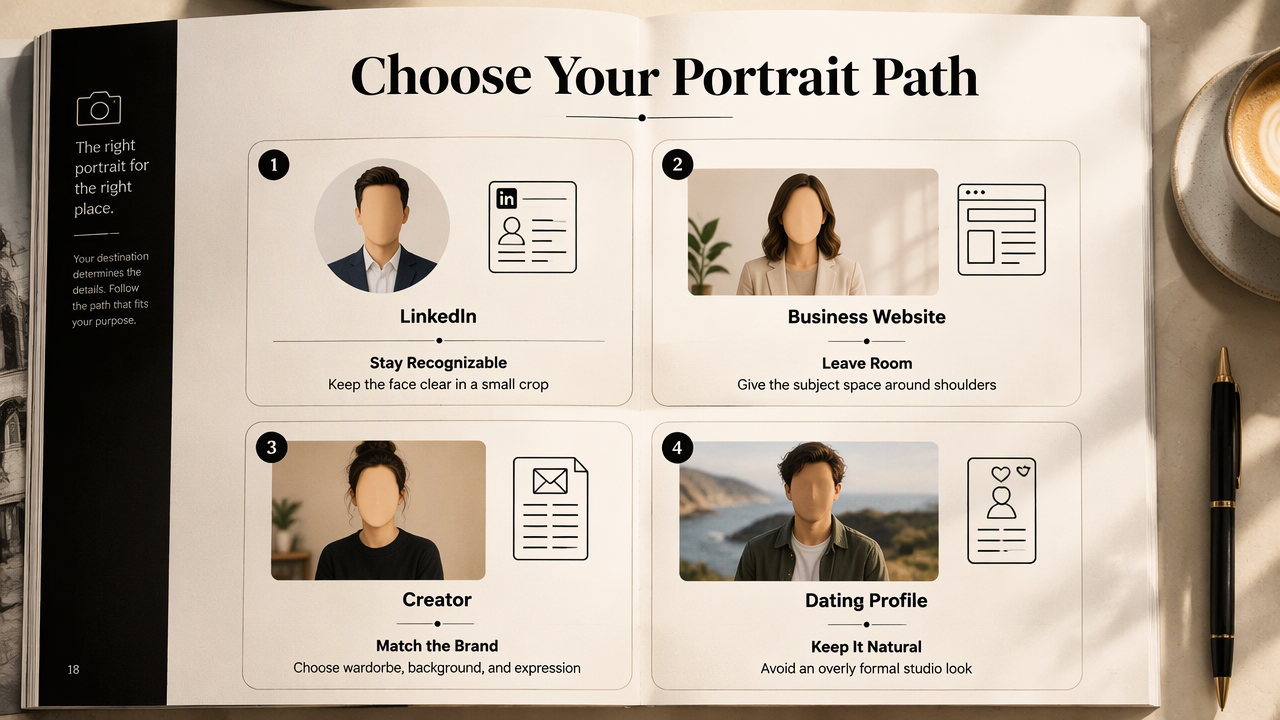
A LinkedIn portrait needs to remain recognizable in a small circular crop. An entrepreneur's website portrait may need more space around the subject. A creator's image might sit beside newsletter text, while a dating profile benefits from a natural-looking setting rather than an overly formal studio treatment.
Personalization controls versus simple selection
Personalization matters most when a buyer has a specific wardrobe, background, expression, or brand style in mind.
Controls should be assessed individually. Selecting a preset is different from adjusting a generated image; both differ from requesting a new generation with precise instructions. A service offering many styles may still provide little control over one finished portrait.
- Job seekers and remote workers: Prioritize recognizable facial features and a clear crop.
- Entrepreneurs: Prioritize suitable framing, wardrobe, and consistency with website imagery.
- Creators: Prioritize flexible compositions that suit several publishing layouts.
- Dating-app users: Prioritize believable appearance and accurate representation.
Delivery format versus revision flexibility
Delivery determines where a portrait can be used, while revisions determine how an almost-right result becomes usable.
A square profile image and a wide website banner have different composition needs. Buyers should compare pixel dimensions, file type, watermark status, and available crops rather than treating every download as equivalent.
Revision terms deserve a separate decision. A new batch, an edit to one image, and a refund are different remedies. The best choice is the workflow that fits the buyer's likely adjustment, not necessarily the largest package.
How Looktara handles this
The platform's published headshot pages support audience-led exploration by connecting portrait use with specific publishing contexts.
That structure offers a useful starting point for professionals who already know where the image will appear. A fitness professional preparing a resume has a different presentation brief from a fitness business owner building a storefront or a creator planning promotional graphics.
Start with the intended publishing destination
The destination pages make the intended context explicit before a buyer compares a portrait workflow.
- Storefront branding: The fitness Shopify and resume headshot page is relevant to fitness professionals exploring business-facing imagery.
- Creator communication: The fitness newsletter and resume headshot page connects the search with a newsletter-oriented context.
- Visual promotion: The fitness Pinterest and resume headshot page offers a destination-specific entry point for fitness content.
These are audience pages, not proof of automatic integrations or particular export settings. Their practical value is helping a fitness-focused buyer begin with a clearer use case.
A short brief can then define the desired outfit, setting, expression, and crop. Keeping that brief constant across shortlisted services makes the comparison more useful.
Context first: A portrait should suit its destination before its styling is judged.
How should headshot services be compared before purchase?
- Define the portrait's destination and required crop.
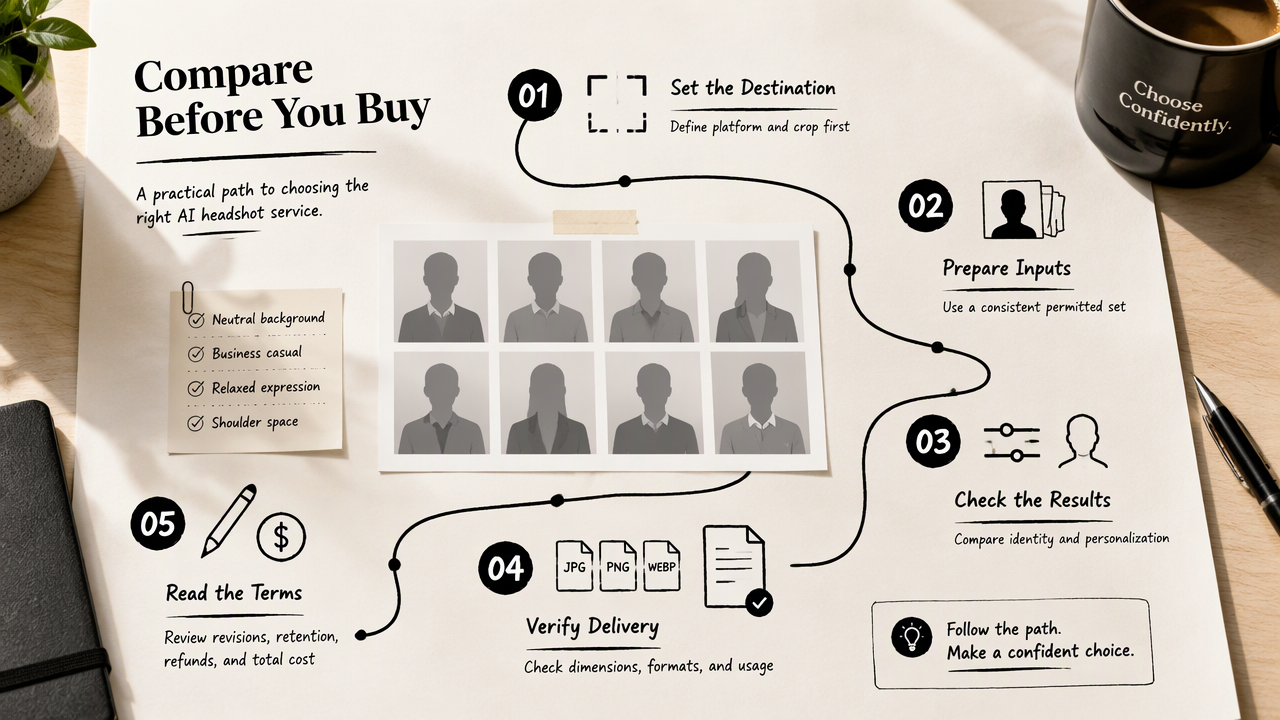
- Prepare a consistent set of permitted input photos.
- Compare identity preservation and personalization controls.
- Confirm delivery dimensions, formats, and usage terms.
- Read revision, refund, and photo-retention policies.
- Calculate the total cost of obtaining a usable final image.
Use a consistent portrait brief
A consistent brief makes differences between services easier to identify.
For example, a freelance consultant might request a neutral background, business-casual clothing, a relaxed expression, and space around the shoulders. Those requirements are more useful than a broad request for a professional photo.
Input instructions also matter. Each service may request different photo counts, angles, or lighting conditions. Buyers should follow the provider's current requirements rather than reuse an unsuitable upload set simply to keep the test identical.
A smaller trial, where available, can help establish whether the workflow fits before a larger purchase.
Judge the portrait at its actual display size
A portrait should pass both a close-up identity check and a destination-size usability check.
At full size, inspect facial proportions, eyes, hairline, glasses, clothing edges, and background details. Then preview the image as a profile thumbnail or within the intended page layout. A pleasing large image may lose clarity when cropped tightly.
Three practical acceptance criteria keep the review focused:
- The person remains recognizably the same.
- The image fits the intended crop without cutting off essential features.
- The styling matches the role or setting without changing the person's apparent identity.
Separate purchase terms from output quality
Clear purchase terms matter even when the sample portraits look convincing.
A free preview doesn't necessarily establish that the final file is free, watermark-free, or licensed for the intended use. Likewise, a regeneration option doesn't necessarily include targeted edits.
Before uploading personal photos, check storage duration, deletion procedures, model-training terms, and available consent information. Team purchases also require permission from each person pictured. These checks belong in the buying process, not after the portraits are generated.
Frequently asked questions about switching from Fotor
Switching decisions usually come down to free access, facial accuracy, professional suitability, and whether a different workflow actually solves the buyer's need.
Buying reminder: Current plan terms are more useful than an old roundup's price or feature summary.
Is there a free alternative to Fotor's AI headshots?
Canva is a relevant candidate because the supplied search research identifies a free AI headshot-generator offering. However, the research doesn't establish its current limits, download conditions, or account requirements. Buyers should distinguish free generation from free final delivery and confirm whether the desired file size, watermark status, and usage permissions are included.
Which alternative produces the most realistic portraits?
The available research doesn't support naming one service as the most realistic. Realism should be judged against the actual person, not against attractive sample portraits. Facial proportions, skin texture, glasses, hairline, and expression provide useful checks. A recognizable image with restrained styling is generally a better profile choice than a dramatic image that changes identity.
Are AI-generated headshots suitable for LinkedIn?
AI-generated headshots can serve as LinkedIn profile images when they accurately represent the person and remain clear at profile size. Buyers should review the finished crop, appearance, and any applicable employer guidance. A professional-looking background doesn't compensate for altered facial features, and a recognizable portrait is more useful than an image that looks polished but unfamiliar.
Should an existing Fotor user switch immediately?
An existing user should switch only when another workflow addresses a defined need, such as more suitable controls, different delivery files, or clearer revisions. If the current tool already produces an accurate portrait in the required format, switching may add unnecessary work. A written list of unmet requirements makes the comparison more focused and the purchase easier to justify.
Conclusion
The strongest Fotor AI headshot alternatives fit a specific portrait brief, delivery requirement, and revision process. Select two candidates, compare current terms, and assess the finished image at its intended display size.
For fitness professionals exploring audience-specific options, Looktara offers relevant destination pages. Visit looktara.com, choose the closest publishing context, and define the portrait brief before selecting a package.
Generated by EarlySEO.com