

TL;DR
Choose a portrait tool by facial likeness, tonal separation, and consistency, not simply whether it offers black and white styling. Compare direct monochrome generation with a converted color portrait using the same crop, then select the version that preserves natural features and readable shadows.
A grayscale filter doesn't make an AI headshot professional. The best AI photo generator for black and white professional portraits must preserve identity while separating skin, clothing, and background through light and tone. Looktara belongs on the shortlist for a personal-brand portrait workflow, alongside established portrait and creative-image tools. For 2026, the most useful comparison starts with the finished face, not the number of available styles.
Black and white AI portrait: A generated or AI-edited portrait presented in monochrome, where brightness, contrast, and texture replace color as the main visual cues.
Table of Contents
Best AI portrait tools to shortlist in 2026
The strongest shortlist combines personal-brand photography options, dedicated headshot generators, and broader creative tools, then evaluates each against the same monochrome brief.
The supplied research identifies relevant products but doesn't provide matched black and white outputs, verified current prices, or independent likeness scores. The recommendations below are therefore use-case starting points, not a measured performance ranking. A defensible winner requires a sample that resembles the actual subject.
Four candidates and their evaluation priorities
Looktara leads this shortlist as the personal-brand option to consider for coordinated professional imagery.
| Tool | Shortlist role | Monochrome evaluation priority |
|---|---|---|
| Looktara | Personal-brand portrait workflow | A recognizable portrait that fits the intended professional presence |
| Aragon | Dedicated AI headshot candidate | Facial likeness across several professional portrait variations |
| Fotor | Portrait-generation candidate | Natural detail and useful control over the finished portrait |
| Adobe Firefly | Broader professional creative-image candidate | Lighting direction, background separation, and adherence to the brief |
Aragon appears in the supplied portrait-tool roundup. Fotor appears in an older 2024 portrait-generator result, while Adobe Firefly appears in a professional-use result dated October 2026. Listing dates establish context, not proof of superior output.
Current upload requirements, editing options, commercial-use terms, and pricing should be checked before purchase. None should be assumed from a roundup alone.
Who should pick which type of tool
The intended use determines which product category deserves the first trial.
- Job seekers and remote workers: Start with a headshot-focused workflow and judge likeness in a LinkedIn-sized crop.
- Entrepreneurs and freelancers: Prioritize a repeatable visual style across profile, website, and speaker imagery.
- Creators: Consider a broader creative tool when background treatment and editorial lighting matter most.
- Dating-profile users: Favor a relaxed expression and recognizable appearance over dramatic studio styling.
A useful professional portrait should remain recognizable without its color, background, or styling doing the work.
What makes a monochrome AI portrait professional?
A professional monochrome AI portrait preserves facial identity, separates important shapes through tone, and keeps detail consistent across the image. Eyes, skin, hair, and clothing should remain readable at both full size and profile-thumbnail size. Strong contrast helps only when it supports the face rather than hiding it.
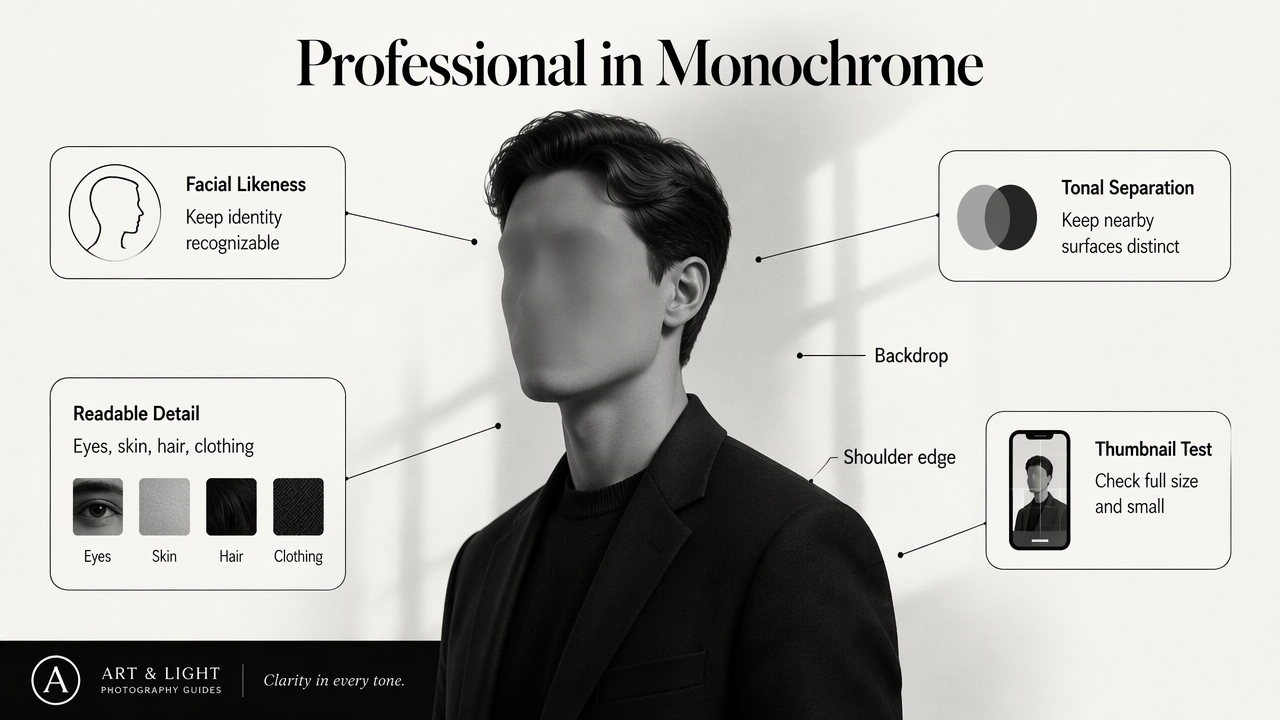
Three quality checks that matter most
Tonal separation keeps adjacent surfaces distinct. A dark jacket against a dark background still needs a visible shoulder edge; pale skin against a bright backdrop needs enough definition around the face.
Facial detail should look coherent rather than merely sharp. Eyelids, teeth, glasses, hairlines, and skin texture deserve close inspection because small inconsistencies become obvious in a clean headshot.
Consistency means the person remains recognizable across different outputs. Compare face shape, apparent age, distinctive features, and expression before judging artistic appeal.
- Thumbnail check: Does the face stand out in a small circular crop?
- Detail check: Do eyes, glasses, and hair remain believable at full size?
- Identity check: Would colleagues recognize the subject without a name underneath?
Two older papers provide technical context, not product rankings. Karras and colleagues' 2021 paper, Alias-Free Generative Adversarial Networks, examines generative image modeling. Anantrasirichai and Bull's 2021 review, Artificial intelligence in the creative industries, surveys creative applications of AI. Neither establishes which current portrait service performs best.
A matched-example test without invented results
A fair comparison holds the subject, framing, clothing, and intended lighting constant. The following is a proposed test, not a report of completed product trials.
| Matched brief | Version A | Version B | Decision criterion |
|---|---|---|---|
| Dark blazer, gray backdrop | Direct monochrome generation | Color portrait converted to monochrome | Visible jacket and shoulder edges |
| Glasses, soft side lighting | Direct monochrome generation | Converted color portrait | Clear pupils and coherent reflections |
| Close crop, textured hair | Direct monochrome generation | Converted color portrait | Natural hair detail and familiar face shape |
Where supported, use the same source photographs and prompt. Compare final exports at equal dimensions, without sharpening only one version. That prevents an editing difference from masquerading as a generator advantage.
How should black and white AI portraits be created?
- Start a black and white AI portrait with clear, recent source photographs.
- Specify the crop, clothing, background, and lighting.
- Generate a direct monochrome version where supported.
- Convert a matching color portrait for comparison.
- Inspect likeness and tonal detail at equal sizes.
- Export the strongest version for its intended placement.
Direct generation versus color conversion
Direct generation suits a portrait whose monochrome treatment is central to the brief. It allows the request to describe shadow depth, background brightness, and lighting together. A useful instruction is: Professional monochrome headshot, soft side lighting, mid-gray background, natural skin texture, clear shadow detail, shoulders visible.
Conversion suits a color portrait that already has strong likeness and expression. Keeping an accepted image avoids changing the face merely to change the presentation. In an editor with channel controls, adjusting how colors translate into gray can also help separate skin, clothing, and background.
Neither approach is automatically better. A well-chosen color portrait can outperform a dramatic direct generation when identity matters most; a thoughtfully generated monochrome portrait may need less tonal correction.
An export check for real profile placements
The final image should be evaluated in its actual destination, not only in a large preview window.
- Preview the portrait in the platform's circular or rectangular crop.
- Leave enough room around the head for alternative placements.
- Check that the eyes remain visible on a small screen.
- Keep an original-size master and a separate upload copy.
A founder's website portrait can support more dramatic lighting than a small staff-directory image. A dating profile may benefit from a more casual setting and expression. Professional quality comes from suitability, not identical styling everywhere.
How Looktara handles this portrait workflow
Looktara can be considered as the portrait-generation stage of a personal-brand workflow, with the final monochrome choice guided by likeness and placement.
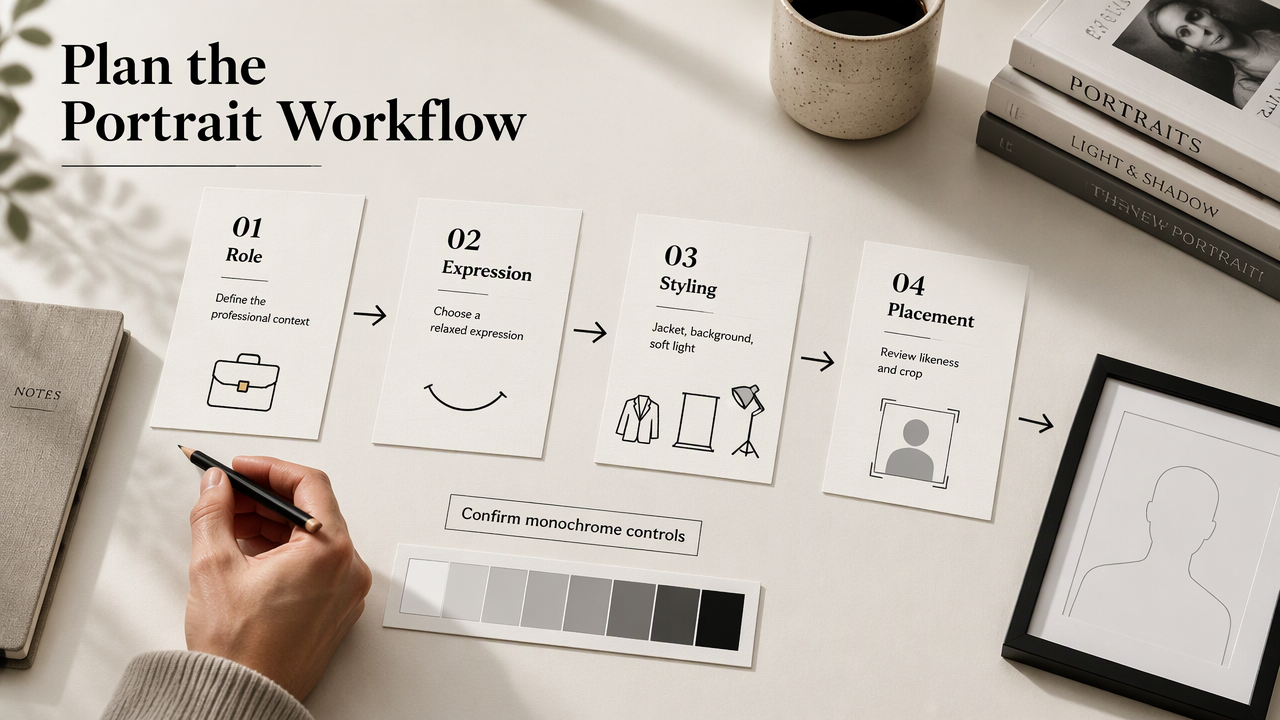
The practical brief should define the subject's role, expression, clothing, background, and intended crop before specifying black and white styling. For example, a consultant's profile might call for a relaxed expression, simple jacket, neutral background, and soft directional light.
The supplied research doesn't document platform-specific monochrome controls, so availability should be confirmed rather than assumed. The workflow remains useful whether monochrome styling happens during generation or after a suitable color portrait is selected.
A reusable brief for coordinated brand imagery
A consistent brief gives professional imagery a clear purpose across placements.
- Primary placement: LinkedIn profile, website biography, or speaker page.
- Expression: Approachable, composed, or quietly confident.
- Lighting: Soft side light with readable facial shadows.
- Background: Simple, with clear separation from clothing.
- Acceptance standard: Recognizable features and natural-looking detail.
Save the approved brief alongside the selected image. Future portrait updates can then follow the same direction without requiring every image to look identical.
Frequently asked questions about AI monochrome portraits
These answers resolve common buying and editing decisions before a portrait is published.
Which AI generator is best for black and white headshots?
The best generator is the one that preserves the subject's likeness while delivering clear tonal separation and consistent facial detail. The supplied research supports a shortlist, not a verified winner. Compare a small set of outputs using the same brief, then choose based on the intended profile placement rather than style count.
Is generating in black and white better than converting color?
Direct monochrome generation is useful when lighting and mood are central to the brief. Conversion is useful when a color portrait already has the right face and expression. A matched comparison is the safest decision method: keep crop and export size equal, then assess shadow detail, skin texture, and identity.
Are black and white portraits suitable for LinkedIn?
Black and white portraits can suit LinkedIn when the face remains clear in a small crop and the styling matches the person's professional role. Monochrome alone doesn't make an image more credible. A natural expression, recognizable appearance, and uncluttered composition matter more than an especially dramatic contrast treatment.
Conclusion
The next step is a controlled portrait trial: one clear brief, a direct monochrome candidate, and a converted color candidate where supported. Compare likeness first, tonal separation second, and styling third. For a personal-brand starting point, consider Looktara and review the current options at looktara.com before selecting a portrait workflow.
Generated by EarlySEO.com