
TL;DR
AI headshots help trade show teams create consistent staff images before directories, badges, landing pages, and follow-up emails go live. The best results come from a shared style guide: matched backgrounds, crop ratios, clothing tone, lighting, and brand personality across every exhibitor profile.
A trade show profile photo often gets seen before a handshake, and inconsistent staff images can make a polished booth look patched together. An AI headshot for trade show exhibitor profiles gives sales teams, founders, speakers, and booth staff a coordinated visual identity without booking a full photo day. Trade show: an organized industry event where companies showcase, demonstrate, and promote products, according to the research definition from Wikipedia. For teams that need brand-ready images fast, Looktara can support profile-photo production alongside related event assets such as a fitness Shopify landing page banner AI generator for campaign pages.
Table of Contents
What is an AI headshot for trade show exhibitor profiles?
An AI headshot for trade show exhibitor profiles is a generated or AI-enhanced professional portrait used in exhibitor directories, event apps, badge profiles, speaker bios, landing pages, and follow-up emails. In 2026, its main value is consistency: every staff member can appear in the same visual style before the event opens.
Competitor SERP results focus heavily on on-site headshot lounges, automated photo booths, and event activations. Those are useful for lead capture, but exhibitor profile images usually need to be ready earlier, when directories, sponsor pages, email campaigns, and badge systems are being finalized.
Key insight: the strongest exhibitor headshot system is not just a nice face photo. It is a repeatable brand asset that fits every pre-show and post-show channel.
Common trade show photo placements include:
- Exhibitor directory: company team cards, sales-contact listings, and hosted-buyer portals.
- Badge profile: mobile-app profiles and QR-code identity pages.
- Landing page: event-specific booking pages, demo forms, and sponsor pages.
- Follow-up email: post-show outreach from sales reps, executives, and product specialists.
- Social promotion: LinkedIn posts, Instagram Stories, and short-form video covers.
A consistent portrait set also helps attendees connect a digital profile with a real booth staffer. That matters most when several people represent the same company across demos, meetings, panels, and networking sessions.
How should exhibitor teams create consistent headshots before a show?
Exhibitor teams should create consistent headshots by choosing one visual standard, collecting source photos early, generating or editing portraits in batches, reviewing them against a shared style guide, and exporting each image for the exact platforms that need it. The process should finish before directory deadlines, not during booth setup.
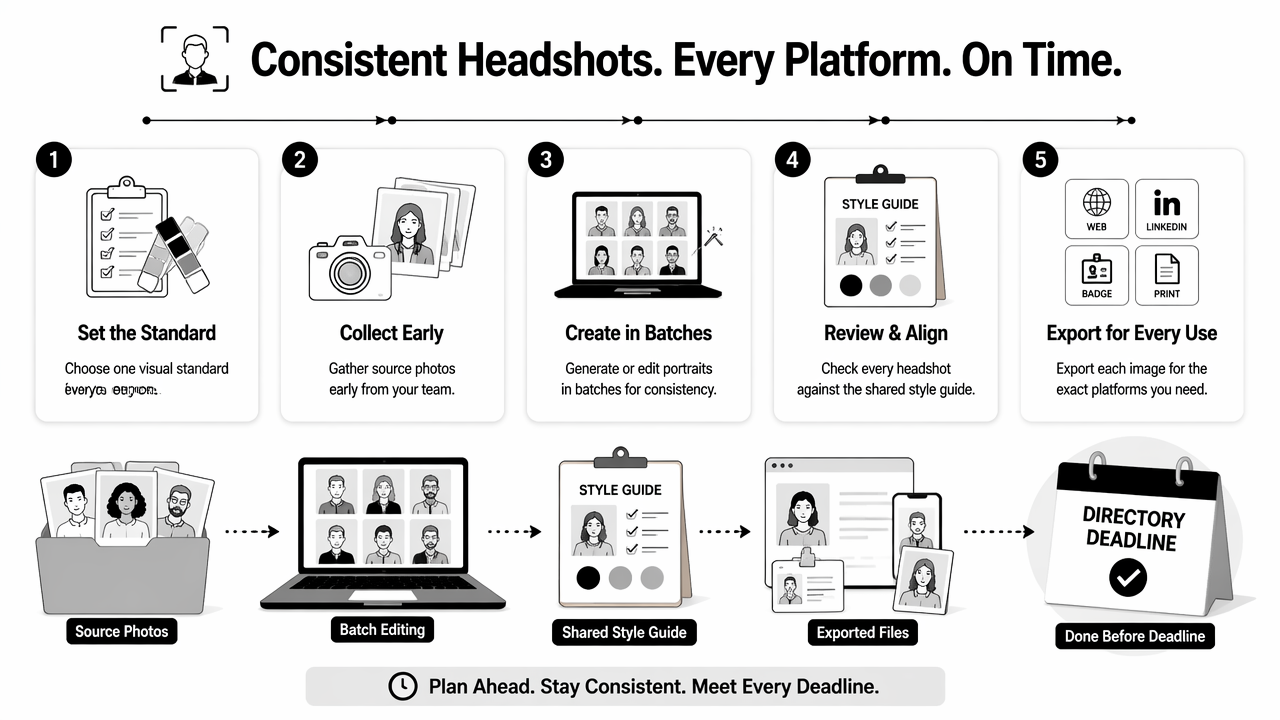
- Set the style before image generation. Choose background color, crop, facial expression, clothing tone, and retouching level.
- Collect usable source photos. Ask staff for clear, front-facing images with simple lighting and no heavy filters.
- Generate portraits in batches. Process similar roles together, such as sales, founders, speakers, or customer success.
- Review side by side. Check that one person does not appear warmer, sharper, larger, or more formal than the rest.
- Export by channel. Save square, vertical, and horizontal versions for directories, email, badges, and social posts.
A single production calendar keeps the work practical. Directory images may be due weeks before the show, while follow-up email graphics can be finalized closer to launch. Event marketers can pair headshots with matching creative from tools such as a fitness Instagram Google Display Ad AI generator when paid retargeting supports booth traffic.
Exhibitor headshot production checklist
| Task | Recommended standard | Why it matters |
|---|---|---|
| Background | One neutral or brand-tinted backdrop | Prevents a mixed directory look |
| Crop | Head and shoulders, eyes in upper third | Fits app profiles and badges |
| Clothing | Solid colors, low pattern, brand-appropriate | Reduces visual noise |
| Expression | Approachable, confident, consistent | Supports trust before meetings |
| Exports | Square, vertical, email-safe file size | Speeds upload across systems |
A friendly but controlled style works better than an overly glossy one. Trade show attendees expect real people, not anonymous stock-photo polish.
Which style guide details make AI headshots look event-ready?
The best style guide for AI exhibitor headshots defines background, crop, clothing, lighting, expression, file format, and brand personality in one short document. The goal is not perfection. The goal is a recognisable staff set that looks professional across every trade show touchpoint.
A trade show can include many industries and visual norms. The research data notes that Venus Berlin, for example, brings together 250 exhibitors from 40 countries and about 34,000 visitors a year. That scale shows why exhibitor images must be clear, scannable, and consistent when attendees browse many profiles quickly.
Practical brand-style rules for exhibitor portraits
- Background: use off-white, light gray, soft blue, or a subtle brand color. Avoid busy office scenes.
- Crop: keep shoulders visible and leave enough space above the head for app cropping.
- Clothing tone: choose business casual, smart casual, or executive formal based on the booth audience.
- Brand personality: define whether the team should feel warm, technical, premium, bold, or creative.
- Retouching: keep skin texture natural and avoid plastic-looking smoothing.
- Accessibility: use strong face-background contrast so small thumbnails remain readable.
Style rule: if every portrait were placed in one row on an exhibitor page, no single image should look like it came from a different company.
Teams promoting event content on social channels can extend the same visual direction into assets such as a fitness Instagram Story AI generator or a fitness Instagram flyer AI generator. Matching the portrait style with event graphics gives the booth campaign a more unified feel.
AI headshot style guide template
| Element | Conservative brand | Modern brand | Creator-led brand |
|---|---|---|---|
| Background | Light gray | Soft gradient | Warm neutral |
| Clothing | Jacket or collared shirt | Clean smart casual | Personal style, simple colors |
| Expression | Calm confidence | Friendly energy | Authentic and expressive |
| Crop | Tight head and shoulders | Medium head and shoulders | Medium crop with personality |
| Best use | B2B services, finance, legal | SaaS, tech, health, retail | Influencers, founders, media |
A written guide prevents subjective review cycles. Instead of debating whether a photo "feels right," reviewers can check each image against the same rules.
AI headshots vs photo booths vs photographers for trade shows
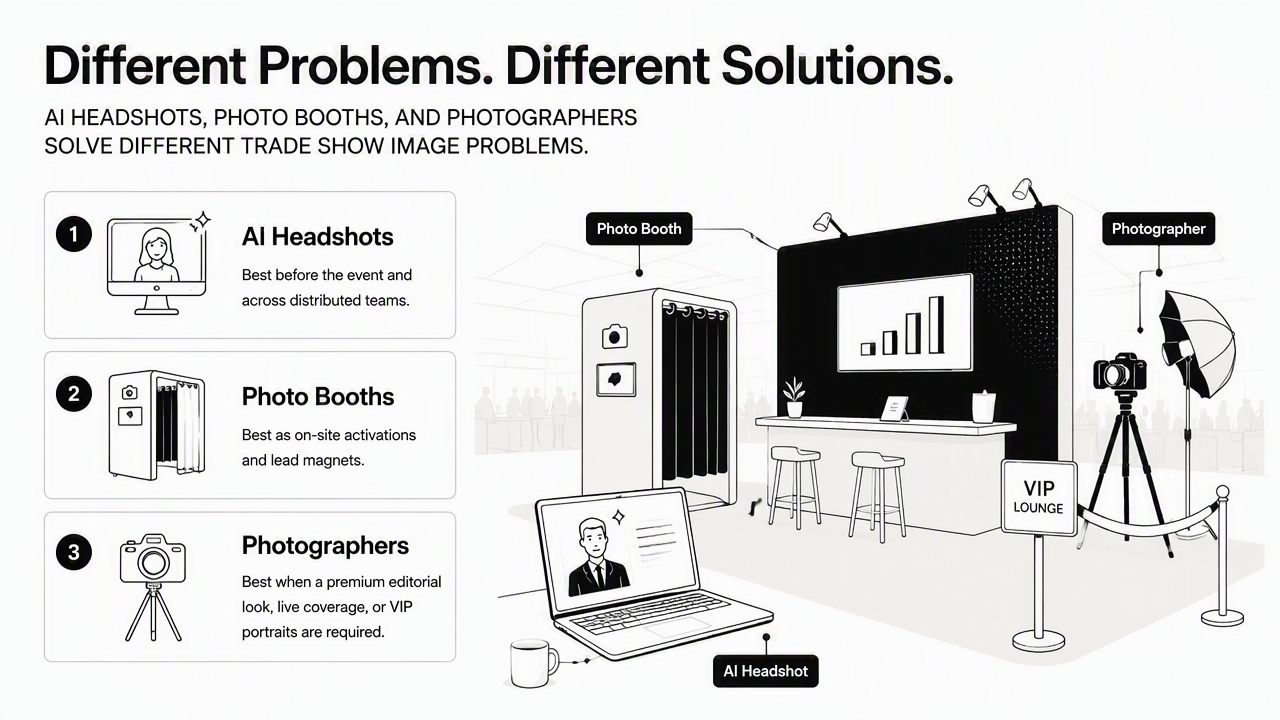
AI headshots, photo booths, and photographers solve different trade show image problems. AI portraits work best before the event and across distributed teams. Photo booths work best as on-site activations and lead magnets. Photographers work best when a premium editorial look, live coverage, or VIP portraits are required.
SERP competitor examples show clear positioning. ExpoTraffic promotes a trade show headshot lounge tied to booth traffic and opt-in lead capture. Studio Pod positions an automated headshot booth for trade shows, with listed pricing from $2,950 per day in the research data. Corporate Event Headshots focuses on AI headshot booth rentals for corporate events, conferences, and trade shows.
Option comparison for exhibitor profile images
| Option | Best fit | Timing | Main limitation |
|---|---|---|---|
| AI headshot workflow | Pre-show profiles, directories, email signatures | Before the event | Needs quality control and style rules |
| On-site headshot booth | Lead capture, sponsor activation, attendee perk | During the event | Profiles may be too late for directory deadlines |
| Professional photographer | Executive portraits, press kits, premium brand imagery | Before or during event | Scheduling and cost can be harder for large teams |
| DIY phone photos | Small teams with informal brand needs | Anytime | Inconsistent lighting, crop, and quality |
The biggest mistake is choosing a method based only on image quality. Timing matters just as much. Exhibitor portals, event apps, speaker pages, and sponsored landing pages often require assets well before booth staff arrive.
A balanced workflow may use AI portraits for directory profiles, a photographer for executives, and an on-site booth for attendee engagement. That mix keeps pre-show materials ready while still creating energy on the show floor.
For video-led promotion, matching portraits with a fitness Shopify YouTube thumbnail AI generator can help teams keep faces, titles, and booth messaging visually aligned across pre-show content.
How Looktara handles event-ready headshot campaigns
Looktara helps event teams treat headshots as part of a larger campaign, not as isolated profile photos. The Looktara platform is a good fit when exhibitor portraits need to match landing pages, social posts, paid ads, and post-show outreach assets across several staff members.
When AI portraits are the right choice
- Distributed team: staff members work in different cities and cannot attend one photo session.
- Fast directory deadline: exhibitor profiles must be uploaded before travel week.
- Consistent sales outreach: follow-up emails need recognizable, polished sender images.
- Multi-channel launch: the same campaign needs portraits, banners, Stories, and ad creative.
Looktara works best when a company has already chosen a style direction. A simple brief can include background color, brand tone, crop ratio, clothing level, and export sizes. That keeps the output focused and reduces late-stage edits.
Exhibitor marketers should also plan where portraits will appear after the show. Sales teams may use them in LinkedIn updates, meeting recaps, recap emails, and webinar invitations. Content teams may pair them with sponsor graphics, product cards, and retargeting ads. For post-show visual promotion, a related fitness Instagram Pinterest Pin AI generator can support ongoing campaign distribution.
Recommended export set for 2026 trade show profiles
| Asset | Format | Use case |
|---|---|---|
| Directory headshot | 1:1 square | Exhibitor portal and app profile |
| Badge profile | 1:1 square, smaller file | QR profile and registration system |
| Email headshot | Small square or circle crop | Sales follow-up and signatures |
| Landing page portrait | 4:5 or 3:4 | Speaker cards and meeting-booking pages |
| Social portrait | 9:16 and 1:1 | Stories, Reels covers, LinkedIn posts |
A strong campaign has fewer surprises when every image is named and stored clearly. File names such as first-last-role-square.jpg help marketing, sales, and event operations find the right portrait quickly.
FAQ about AI headshots for exhibitor profiles
AI headshots for exhibitor profiles raise practical questions about timing, realism, brand fit, and where the images can be used. The answers below focus on trade show workflows in 2026, especially directories, badge profiles, landing pages, and follow-up emails.
How early should exhibitor headshots be created?
Exhibitor headshots should be created as soon as the booth team list is stable, ideally before directory and event-app deadlines. A practical timeline leaves time for staff photo collection, AI generation, review, edits, file naming, and uploads. Late image production often causes mismatched crops or rushed profile pages.
Can AI headshots be used for badge profiles and event apps?
AI headshots can be used for badge profiles and event apps when the event platform accepts standard image files and the portraits accurately represent each person. Teams should check size, file type, and crop requirements before exporting. A square version usually works best across directories, badges, and mobile profiles.
What makes an AI headshot look trustworthy?
A trustworthy AI headshot looks like a real professional portrait, with natural skin texture, accurate facial features, clean lighting, and a believable expression. Overly smooth skin, distorted glasses, strange teeth, or artificial backgrounds reduce confidence. Side-by-side review across the full team helps catch those issues before upload.
Should every booth staffer use the same background?
Every booth staffer should usually use the same background or a very close variation. Matching backgrounds make exhibitor pages easier to scan and help the company look organized. Small role-based variations can work, such as a more executive crop for leadership and a friendlier crop for customer-facing staff.
What is the next step for a trade show team?
The next step is to create a one-page headshot style guide, collect staff source photos, and export images for every channel before the event portal deadline. For teams building a full event campaign, visit looktara.com and align portraits with booth banners, social creative, and follow-up assets.
Conclusion
A strong AI headshot for trade show exhibitor profiles gives every staff member a polished, consistent identity before attendees open the event app or receive a follow-up email. The practical path is simple: define the visual style, generate portraits in batches, review the set side by side, and export each file for directories, badges, landing pages, social posts, and email. Teams preparing a 2026 show should start with a shared style guide, confirm upload specs, and use Looktara when headshots need to fit a larger event-marketing system rather than stand alone.
Generated by EarlySEO.com